
book_info --id=001 --lang=en
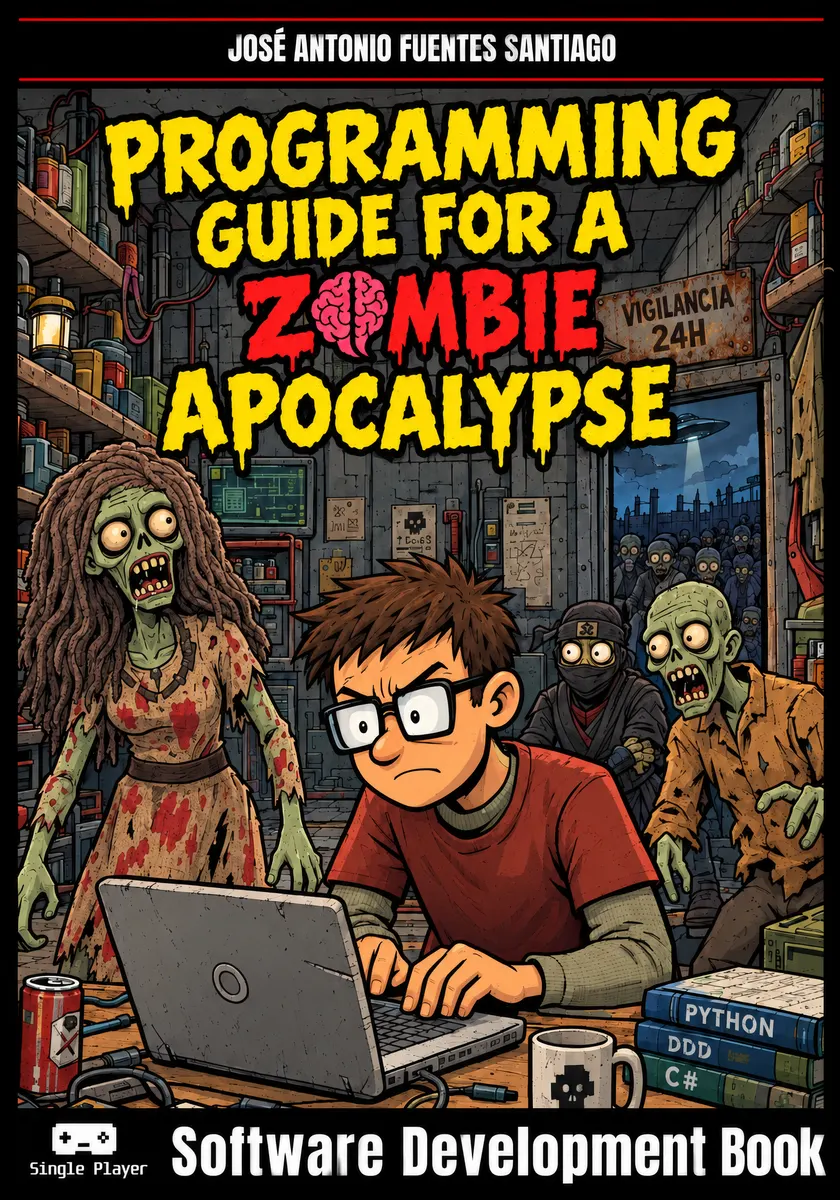
Programming Guide for a Zombie Apocalypse
2nd edition · Learn TypeScript while surviving the end of the world.
- AUTHOR
- José Antonio Fuentes Santiago
- LANGUAGE
- English
- STATUS
- published
- THREAT
- BEGINNER
- FORMAT
- Paperback / Kindle
- TOPIC
- TypeScript
get it on Amazon
synopsis
When the world falls apart and the systems stop working, all you have left is what you know. This guide teaches TypeScript from scratch while you survive a zombie apocalypse: every chapter starts with a problem in the shelter and solves it with code, so you learn to program the way you would pack your backpack before fleeing the city.
Four blocks take you through the fundamentals of modern programming: variables, functions, and arrays; object-oriented programming with classes, inheritance, and interfaces; and, to finish, errors, async code, and tests.
Between lessons you'll find Survivor's Tips, Notes from the Cabin, hands-on exercises, and a challenge at the end of each block to put what you've learned to the test.
contents
- B1Programming fundamentalscomments, variables, types, operators, conditionals, loops · Challenge: 7-day survival simulator
- B2Functions and data structuresfunctions, math, arrays, strings, dictionaries, other types · Challenge: shelter management system
- B3Object-oriented programmingclasses, inheritance, static members, abstract classes and interfaces, polymorphism, association · Challenge: prison defense towers
- B4The first winter in the prisonerrors and exceptions, async code, tests · Challenge: the night of the north wall
- AWhen the metal detector beepscommon errors
- BLearning to program with an AI by your side
- +Glossary, bibliography and keyword index
about this edition
- Second edition, revised and expanded. Four blocks, four challenges, two appendices.
- New block on errors and exceptions, asynchronous code and simultaneous tasks, and unit tests, with its own challenge.
- Two appendices: common TypeScript errors explained, and how to use AI to learn while you code.
- New bibliography section, a glossary trimmed to the terms that matter, and a keyword index.
- Chapters 11, 12, and 14 add Set, the ?. and ?? operators, interface types, optional properties, literal unions, spread, destructuring, JSON, override, getters and setters, and private fields.
- All example code reviewed and exercises streamlined.