
book_info --id=002 --lang=en
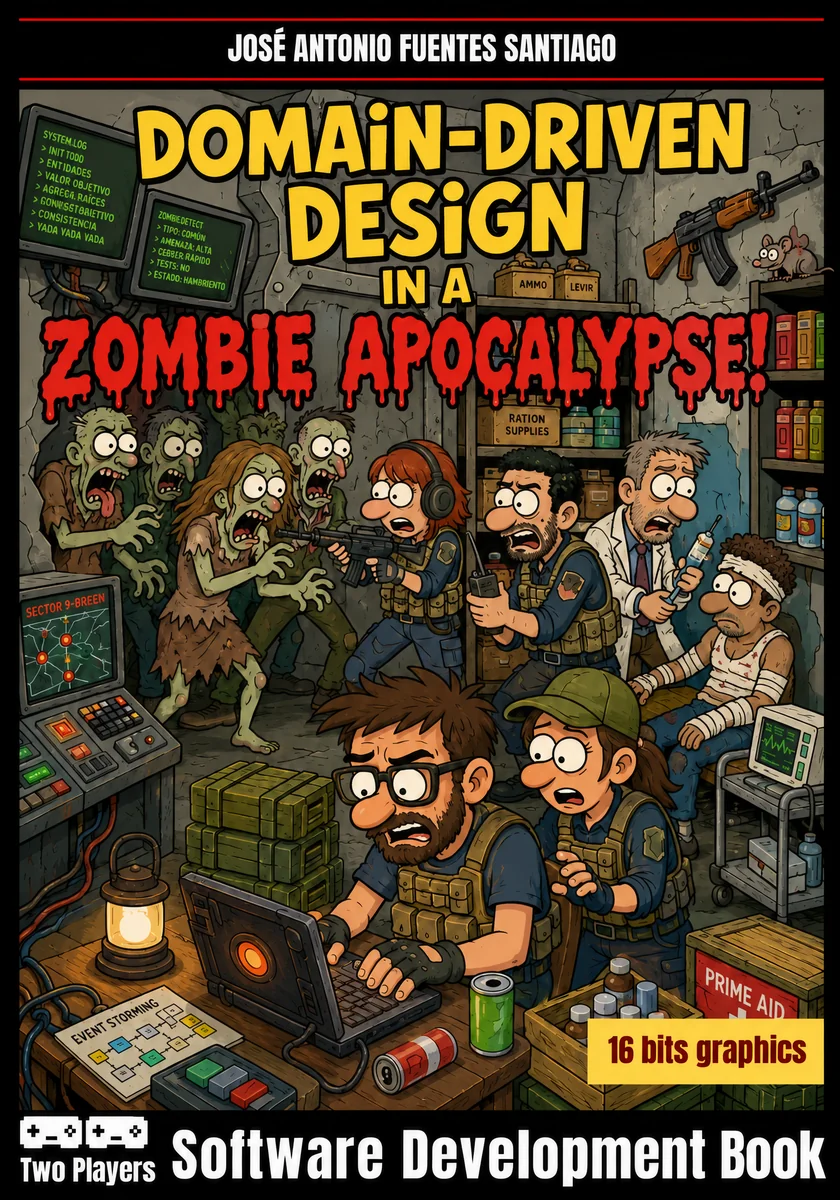
Domain-Driven Design in a Zombie Apocalypse
Learn DDD while preparing a shelter to hold off the zombies.
- AUTHOR
- José Antonio Fuentes Santiago
- LANGUAGE
- English
- STATUS
- published
- THREAT
- INTERMEDIATE
- FORMAT
- Paperback / Kindle
- TOPIC
- Domain-Driven Design
get it on Amazon
synopsis
A programming book in the age of AI? Yes, really. We live in a time when artificial intelligence can help you build in days (even hours) projects that used to take months. But when that project starts to grow and the problems show up, you'll find that, if you didn't review what the AI did, it's on you to understand, organize and keep control of everything it created.
In this book you'll learn to design code so that you can understand what each change means, keep complexity under control and let the project grow in a sustainable way.
Because Domain-Driven Design proposes something that, obvious as it may sound, isn't always easy to achieve: that the code speaks the same language as the business.
Forget about wading through a heavy academic treatise or a catalog of patterns you'll abandon at the first chance. This is a practical guide based on experience applying DDD in real projects, explained step by step and without assuming you already know it all.
And yes, there are zombies. Because learning to design software while surviving an apocalypse is a lot more fun than doing it in front of architecture diagrams.
contents
- B1Survival strategy (strategic design)ubiquitous language, bounded contexts, context map
- B2The pieces of the domain (tactical design)entities and value objects, aggregates, domain services
- B3The machinery (infrastructure and flow)repositories, application layer, domain events, hexagonal architecture
- B4The immortal shelter (quality and resilience)sagas, antipatterns and common mistakes, tests, Event Storming
- AWhen to use DDD (and when not to)
- BDDD in other domains
- CFrequently asked questions
- +DDD checklist, glossary and bibliography
about this edition
- First edition.
- Fourteen chapters in four blocks, with a summary at the end of each block.
- Based on experience applying DDD in real projects.